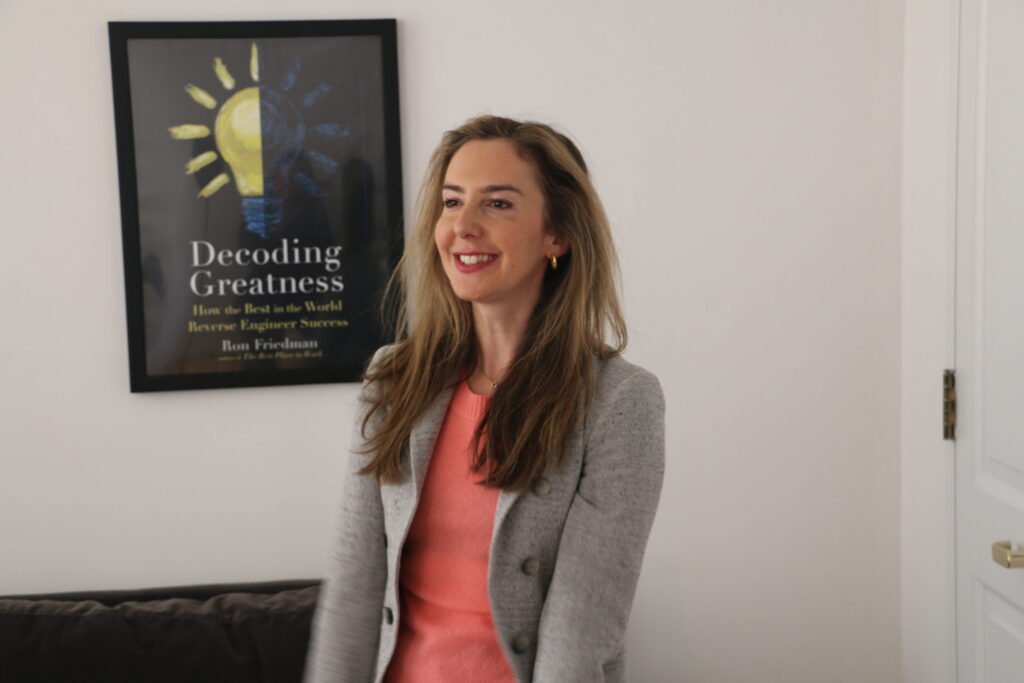
Karlyn Ankrom has watched the same scene play out with author after author. Years spent writing the book. Months spent launching it. One triumphant week promoting it. And then, almost overnight, silence — and an author standing in the quiet asking, “Okay… now what?”
“They were sitting on hundreds of pages of incredible intellectual property,” Karlyn says, “but they didn’t necessarily have a system for using it.”
That gap is where Karlyn has built her career. She’s the founder of Oh Snap! Social, a social media agency she started in 2015, and she teaches marketing workshops and bootcamps through the American Marketing Association. Somewhere along the way — after years of working with a broad mix of businesses and organizations — she noticed nonfiction authors and thought leaders kept hitting the same wall, and she started building something specifically for them.
From “What Should We Post Today?” to “What’s the Story?”
Karlyn didn’t come up through social media marketing. She came up through journalism, and it still shapes how she works.
“I’m less interested in ‘What should we post today?’ and much more interested in: What’s the story? Who are we talking to? What do we want them to know, feel, or do next?” she says.
That instinct is what eventually pointed her toward authors specifically. She kept seeing writers who’d poured years into a book only to treat the launch as the finish line — not realizing the book itself was raw material for everything that could come next. Today, her work is focused on helping nonfiction authors, speakers and experts turn ideas they’ve already created into an ongoing visibility engine, one that supports the bigger business: speaking, consulting, workshops, clients, partnerships, the next book.
“Your book isn’t the finish line,” Karlyn says. “In a lot of ways, it’s where the really interesting stuff can start.”
One Page. One Line. One Post.
Ask Karlyn what’s made the biggest difference in running her business and keeping content consistent for clients, and she doesn’t point to a piece of software. She points to a mindset shift.
“The biggest shift for me was realizing that content cannot depend on inspiration,” she says. “If every Monday morning you open Instagram or LinkedIn and ask yourself, ‘What should I post this week?’ you’ve already made the process harder than it needs to be.”
Instead, she works backward: What are we trying to accomplish? Who are we trying to reach? What do those people care about? What expertise or intellectual property do we already have? For authors specifically, that process has a name — One Page → One Line → One Post.
“Open your own book to a page. Find one sentence, story, idea, framework or opinion. Then ask: What conversation could this start today?” Karlyn says. That single idea might become a LinkedIn post, a Reel, an email, a podcast talking point or a conversation starter.
She also protects her own process fiercely — batching content whenever possible (“I’d rather spend focused time identifying 20 strong ideas than interrupt myself 20 different times trying to come up with one”) and guarding her calendar with a standing No Meeting Monday. “That gives me actual space to think, create and work on the business instead of spending the entire week reacting to it,” she says. “Systems should reduce the number of decisions you have to make, not give you another complicated system to manage.”
Where AI Helps — and Where It Can’t
Karlyn uses AI every day. She’s also unusually clear-eyed about its job description.
“AI is fantastic at helping you organize, repurpose, synthesize, brainstorm and get past the blank page,” she says. “For an author, that’s incredibly powerful because you already have the raw material. You have a book. You have interviews. You have talks. You have stories. You have frameworks. You have years of expertise. AI can help you find more ways to use all of that.”
What she won’t let it do is replace an author’s perspective. “Information is everywhere now. Perspective is rare,” she says. “If I ask AI to write a generic post about leadership, it can give me a perfectly competent leadership post. So can everybody else. But AI wasn’t in the room when you learned the lesson that changed the way you lead. It didn’t have the client conversation that made you rethink something you’d believed for 20 years.”
Her guidance to authors is blunt: let AI handle the labor, but don’t outsource the lived experience. “The best AI-assisted content should still make someone who knows you say, ‘Yep. That sounds exactly like you.'”
Building a Platform Before the Deal
For authors trying to build a platform ahead of a book deal, Karlyn says the real starting point isn’t a platform at all — it’s a question. “Who needs to know you exist?”
She’s wary of how quickly “build a platform” turns into an overwhelming, follower-count-driven assignment. “You don’t necessarily need the biggest audience. You need the right audience paying attention,” she says. For a business author, consultant or speaker, that might mean LinkedIn, where the people who could hire, invite, recommend or interview them are already spending time. For someone else, it might be Instagram, YouTube, TikTok or Substack. “I don’t want someone choosing a platform because somebody told them, ‘Authors have to be on TikTok.’ I want them asking: Where does my audience already spend time, and what kind of content can I realistically create well and consistently?”
From there, she pushes hard on point of view. “Don’t just teach me five leadership tips. Tell me what everybody in leadership gets wrong. Don’t just summarize your future book. Tell me the story that made you need to write it,” she says. “That is what starts turning an audience into a platform.”
It also has to be sustainable for the person creating it. Karlyn points to her work with psychologist Nicole McNichols and Lucinda Literary client as an example: they built her presence around exactly two formats she was already comfortable with — video on Instagram and carousel posts repurposed from her Psychology Today articles — and only expanded to TikTok once Instagram was established, by repurposing her top-performing Reels. “After you get clear around the where and the content angles, you have to be real with yourself about the type of content you can be consistent with,” she says.
What Collaboration Actually Looks Like
Authors sometimes assume working with Karlyn means becoming a full-time content creator. It doesn’t — but it does mean giving her access to what’s in their head.
“The best collaborations happen when I can get the author’s stories, opinions, language, experiences and expertise out of their head,” she says. “The book gives us a tremendous starting point. Then I want the things that aren’t necessarily on the page.” What happened after publication? What question came up after a keynote? What are they seeing with clients? What are they sick of hearing about their industry? What changed their mind recently?
Depending on how they work together — through her done-for-you agency or her cohorted group program — that exchange happens through strategy sessions, interviews, content collection sessions, or an author reviewing and reacting to ideas Karlyn brings them. “I don’t need an author sitting in Slack with me five days a week,” she says. “But I also don’t believe in completely removing the author from their own thought leadership. We’re building your presence, not my very convincing impression of you.”
The Pattern Behind Author Success
Ask Karlyn what separates authors who build real momentum from those who don’t, and one pattern comes up immediately: they stop treating every post like it has to be a masterpiece.
She tells the story of an author who hadn’t posted about her book in months, stuck overthinking the packaging of every idea. Once they got clear on who she was talking to and what she wanted the book to do for her, she posted a simple photo of herself holding the book — nothing elaborate — and it generated more than 45 engagements. “The important part wasn’t the number,” Karlyn says. “It was that she posted. She had gotten herself so stuck thinking the content needed to be more complicated that she wasn’t using the asset sitting right there in her hands.”
The other recurring breakthrough is realizing an author has more than one audience. “Suddenly the messaging gets easier because we’re no longer trying to make every single post speak to every possible person,” Karlyn says. The authors who get the most out of the work, she’s found, are willing to experiment, willing to repeat themselves, and willing to stay in the conversation after the initial excitement of publication fades — “because you are going to get tired of your message long before your audience has actually heard it enough.”
The Mistakes That Stall Momentum
The biggest one, by far: disappearing after launch. “You spent years writing this thing. Please do not give it seven business days of Instagram posts and declare the marketing complete,” Karlyn says.
A close second is assuming the publisher will carry the marketing load. “Publishers can absolutely support a launch, and there are wonderful publishing teams doing great work,” she says. “But ultimately, your audience and your platform are assets that belong to you. No one is going to care more about your book than you, full stop.”
She also flags a subtler mistake: creating content without knowing who it’s for. “If you’re talking to ‘everyone who could benefit from my book,’ your content is probably going to feel incredibly generic,” she says. Specificity, in her view, is what makes both the audience and the algorithm recognize who a piece of content is for — including the people not yet following an author. “That’s the power of where social media is right now, in this moment. It’s more of an interest platform. Great thing, because it gives those of us without a huge following equal opportunity to show up in our ideal client’s feed. On the flip side, you could have 100,000 followers and maybe only 25% of them see your content.”
And finally: constantly creating instead of repurposing. “Authors tell me, ‘I don’t know what to post.’ And I’m thinking, ‘You wrote 60,000 words!'” Karlyn says. “The problem isn’t a lack of content. It’s a lack of a process for seeing what you’ve already created as reusable material. Your book should be one of the first places you look for content ideas, not something you put back on the shelf once launch week ends.”
Why the Book Isn’t the Finish Line
Karlyn sees an unconscious finish-line mentality baked into how authors think about the publishing timeline — proposal, deal, publication, launch week — and none of it, in her view, is actually the finish line. “What happens on Tuesday three months later? Your book didn’t suddenly become less useful because it isn’t new anymore,” she says.
A published book, she argues, is a credibility asset — one that can open stages, companies, podcasts, consulting engagements and conversations that weren’t accessible before. Social media is what keeps those ideas circulating, to the masses, for free. “The person following you today because of one LinkedIn post might buy your book six months from now. They might recommend you for a keynote next year. They might be first in line for Book #2.”
That’s the post-publication plateau Karlyn talks about so often — the natural dip in energy once launch buzz fades. Her advice isn’t to fight it by shouting “buy my book” indefinitely. It’s to make a deliberate shift: “The goal is to transition from promoting the book to building conversations around the ideas inside the book. That’s a smarter strategy.”
Where to Start
Karlyn is teaching a free class later this month for nonfiction authors asking exactly that question — “I wrote it, I launched it, why isn’t this creating the opportunities I thought it would?” The class digs into what happens after launch and how to turn the ideas already inside a book into content that builds visibility, credibility and opportunity, without turning social media into a second full-time job. It’s happening September 29 — you can register here.
Beyond the class, authors can work with Karlyn in two ways: one-on-one strategy and content through her agency, Oh Snap! Social, or through the Expert Excellence Engine, her program for authors and experts who want the full system behind their visibility — audience, goals, messaging, content ecosystem, how AI fits in, how to repurpose existing intellectual property, and ultimately an Owner’s Manual for keeping the engine running long after the program ends.
“I don’t want an author leaving with 30 posts and then asking, ‘Cool… what do I do on day 31?'” Karlyn says. “I want them leaving knowing how to keep the engine going. The goal isn’t to make you better at social media for the sake of being better at social media. The goal is to make sure this book you spent years creating actually helps you get where you want to go next.”
Watch the interview now