Search
Lucinda’s Birthday Issue: What You Learn While Writing Your First Book
Lucinda Halpern shared her latest publishing insights from this month. Read on to see her latest news, and if you’d like to receive her monthly newsletter directly in your inbox, sign up here.
# # #
October is my birthday month, but unlike the majority of people, aging doesn’t bring me down. I’ve always sought out older friends and mentors in my search for wisdom. As I age, I rejoice at opportunities to learn and grow, to innovate and experiment, and I see the next decade as a time of ripening for Lucinda Literary, between the growing diversity of our clients and the multitude of our offerings for writers at large.
When I reflect back on this year for Lucinda Literary, I think about some pretty big wins for our authors like Lauren LaRusso; Jaunique Sealey; Casey and Meygan Caston; John Feal and Charles Daly. Just last week, another win occurred with the auction for an entrepreneurship proposal called FEAR IS A LIAR by Ross Buhrdorf, the CEO of a company called Zen Business that I fell upon 2 years ago. And not to mention the successes of my colleagues’ array of book deals in this year alone—too many to count.
I also think about the launch of our multiple events, ranging from those with Dorie Clark to Hay House, to our Race to Query Contest, to the launch of our Book Accelerator Workshop.
If you’re just starting out, explore our beginner resources on Get Signed
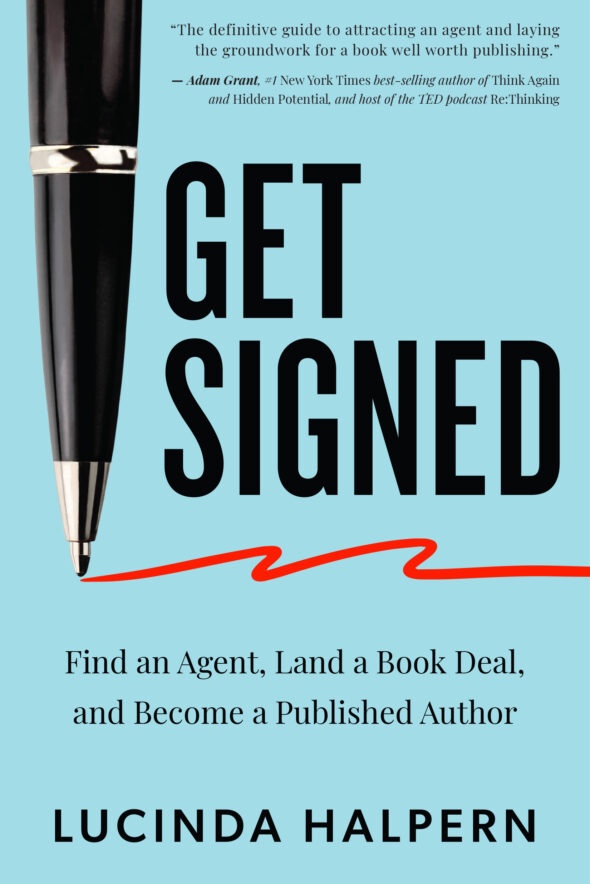
Amidst these activities, the highlight of my year happened in February with the birth of my book Get Signed, one of my longest held dreams that I never expected to come true in quite the way it did.
As I say in the book, sometimes the book we are born to write is the one that seemed too natural, too easy, and therefore overlooked. It wasn’t until almost a decade of working alongside writers and publishers of all kinds in both an agenting and teaching capacity that something clicked, urging me to turn the knowledge I had to offer into a book. Now, eight months later, I’m amazed to think back on my long journey of becoming an author.
Your path to becoming an author will be different from my own. Maybe you identify as a methodical creator, moving at a steady and careful pace. Isn’t the expression that “slow and steady wins the race?” Or maybe you’re a “move-fast-and-break-things” kind of person like me, and a book deal will happen unexpectedly.
Whatever way you’re wired, you can become an author—on your own unique timeline. And with that, I’d like to share something: my lessons (expanded and updated!) on writing and launching my first book, Get Signed: Find a Book Deal, Land an Agent, and Become a Published Author (Hay House; 2024), a playbook for aspiring authors.
Lesson #1: It all begins with your reader avatar.
Greg Alexander’s The Boutique was one of the first business books I had read that introduced me to the idea of a customer avatar. I re-fashioned this idea for Get Signed, and spent hours scheming and refining a reader avatar based on the students I had met in our classes. In other words, I thought critically about how I could create a book that spoke to them, in the exact language I had heard. As part of my market research, I had to familiarize myself with the content they consume—and would pay for.
Here’s my resource to help you build your own reader avatar.
Lesson #2: Find the right collaborator.
I always thought I was a strong writer. I wasn’t. At least, my writing wasn’t strong enough to write a long-form practical self-help book. So, I engaged Liz Morrow to help me as a thought and editorial partner. We had so many rich debates on Zoom and over Voxer. When I read the book now, I see all of those creative struggles—the ways in which we found solutions, the areas in which we couldn’t.
If you work best collaboratively, a partner who is as dedicated and brilliant as Liz is essential. Without a Liz in your life, you cannot just rely on your spouse or editor to be in the trenches with you, while also offering a well-rounded perspective. (Lucinda Literary represents a number of talented collaborators who can help authors through ghostwriting, outside editing, or coaching.)
Lesson #3: Voice is best, better than the rest.
When I consider the singular reason an editor will acquire a project (or pass on it), it comes down to voice.
I struggled infinitely with writing as my English literature education, as well as my mother (the best editor I know), filled in my head. But my actual editor at Hay House had to whack me around a few times and say: “Don’t strive for perfection. We want your voice. Just as you would say things, not as you would write them.”
I tell my authors this all the time, even though I had such trouble doing it myself. Perfection is so often the enemy of the good. I found that the more brief and spare and essential I was with my prose, the more it sang.
After reading On Writing Well, I cut, and I cut, and I cut ruthlessly. And now I apply this to all of my writing.
If you’re just starting out, explore our beginner resources on Get Signed
Lesson #4: Engage a reader committee, well before you think your manuscript is “ready.”
Here’s another way in which perfection goes against the grain of the good. We neglect those critical readers who can tell us what’s working well and what isn’t before we’re too far along. Getting a sense of this early, no matter how self-conscious you are, can help you determine the structure of your book, avoid repetitive or trite concepts, and save you from negative Amazon reviews later.
Here’s an example of the survey I shared and used for my own reader committee, a small, hand-picked list of editors, ghostwriters, authors, and most important, the students and aspiring authors I teach, who comprise the bulk of the book’s audience.
Lesson #5: Don’t fall into the email trap.
Editors and agents are oversubscribed. Most new authors (guilty!) have questions arise night and day, and we are often ahead of ourselves—asking who to approach for blurbs before we’ve even delivered a manuscript. Too many questions and emails will drain your editor or publicist’s attention. But these questions do deserve answers—at the right time. To avoid inflicting death by a thousand emails on your editor, consider making an ongoing list of questions in a Google doc, organized by answered vs. unanswered to keep track. For the older school, consider scheduling a 30 minute Q&A phone call with an agenda sent beforehand or one kept on hand. For the newer school, you might send a Loom that walks an editor through particular questions.
I can’t vouch every editor will take to this… but it worked for me.
Lesson #6: Create a cover inspo deck.
After a decade of having teary “I hate my cover!” conversations with authors, I now recommend that my authors get out in front of the inevitable early. Once your manuscript is in, create a deck, or even just a document, to act as a vision board for how you wish your cover to appear. Two points to highlight here:
1) Be really specific in providing instruction or feedback as to what you like or don’t like, and be able to name why.
2) Don’t choose book covers in genres or with audiences that are entirely different to yours. A beautifully packaged novel from Knopf (they do the best jackets!) is likely not the way your self-help book should appear.
Here’s an example of what I created here.
If you’re just starting out, explore our beginner resources on Get Signed
Lesson #7: Don’t tackle everything at once!
So many of us are busy with careers, families, and now, a book! It’s tempting to think we can juggle everything at once, but at the end of the day, it’s best to space yourself out. For example, I incorporated “Offline Wednesdays” into my schedule in order to dedicate one entire workday out of the week to just my upcoming book.
Similarly, keep a schedule of action items that should be accomplished in a linear, time-blocked way (as close to being anal-retentive as you can get), so that you’re not scattered and rushed during launch time. When I got my book deal, I divided up the objectives quarterly—i.e. “blurbs,” “publicity outreach,” and “presales.”
Lesson #8: Read the book aloud before you deliver the final draft.
I loved reading the audiobook for Get Signed. It was challenging in the best possible way. All that diaphragm! But ready for my big mistake? I hadn’t read the manuscript aloud before I turned it into my editor. I had been telling my authors to do so but hadn’t found the time myself and was frankly sick of re-reading that manuscript! As a result, there were repeated or tongue-tripping words and a few repetitive concepts I could have easily avoided. By reading aloud, I also would have realized that maybe my practical content would have been better balanced with personal story. Or that too many of my book examples featured similar characters.
OK… not venting. Just saying: lesson learned. Maybe I could have hired someone?
As I mentioned, no two publishing paths look alike, and I’d love to hear some of your own experiences as you continue on this journey! I hope to learn something from you, as I hope you’ve discovered something from my own story.
Happy writing my beautiful authors! Wishing you a wonderful fall ahead.
If you’re just starting out, explore our beginner resources on Get Signed